This is Team Animalkind
Through our experience speaking with children, we have found that most children would choose to live vegan if they were properly informed and had a genuine choice. We see it as our responsibility to educate them about the ethical injustices that are presented to them as normal, so that they have the chance not to become animal exploiters themselves.

Our educational mission
We engage in conversations with children and people who rely on simple language and explain that the use and consumption of animal products inherently involves the exploitation of animals. Together with them, we explore their values, which are almost never hostile toward animals, and we show them the solution if they themselves do not want to exploit animals: living vegan.
We help children find ways to live vegan and try to encourage the adults around them to support them in this, which they are obligated to do under the UN Convention on the Rights of the Child.
Articles 12 and 13 of the UN Convention on the Rights of the Child state that children have the right to form their own opinions, to express them freely, to receive and share information and ideas, and to have their views duly considered.
We support families in living vegan
online through our website and our family community,
offline through personal exchange and family meetups
Our materials
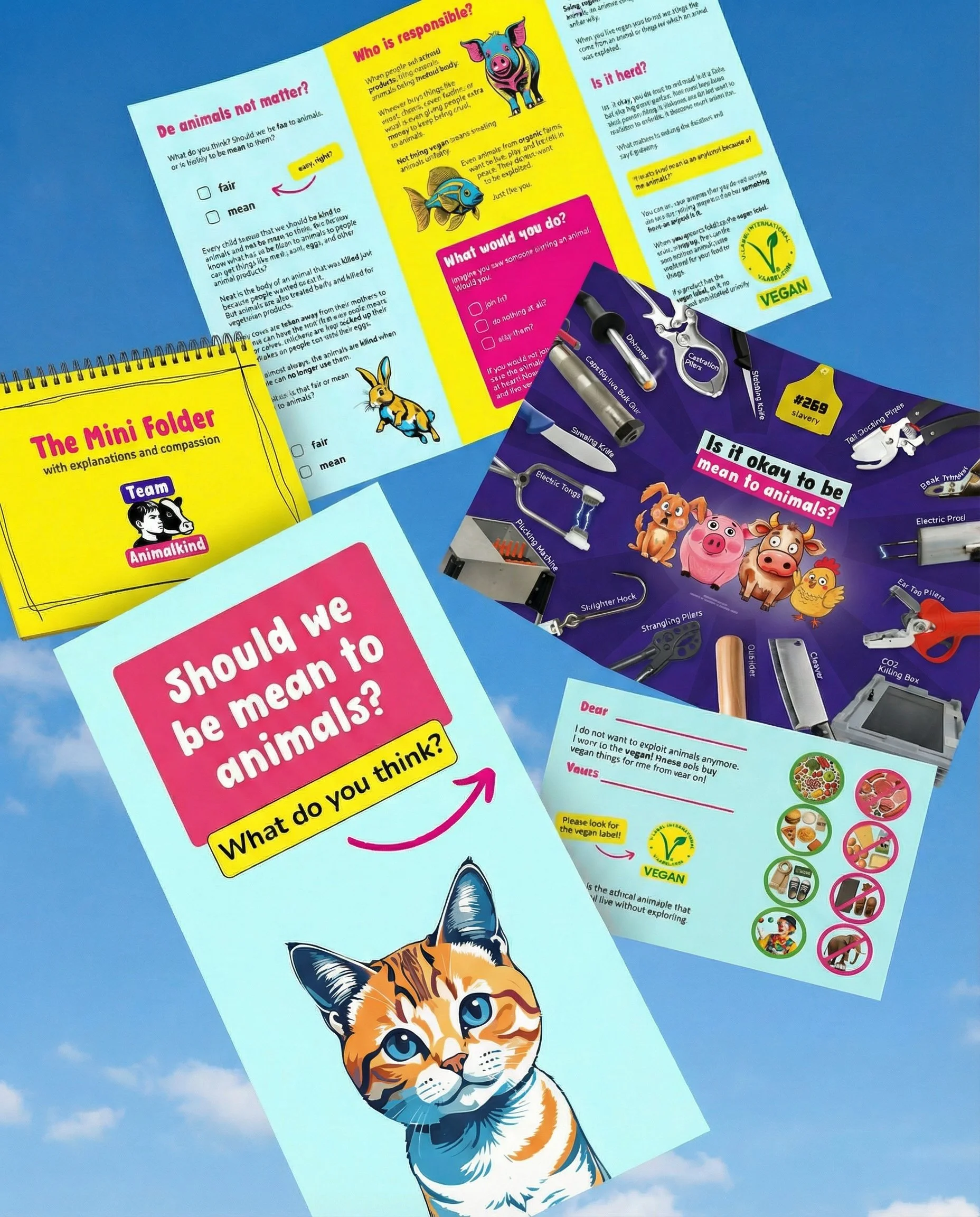
Team Animalkind uses outreach materials designed specifically for children and their families, including flyers, outreach signs, and interactive cards. Research* shows that colors play an important role in how children learn and process information, which is why our materials use clear visuals and bright colors to make ethical ideas easier to understand.
The outreach sign invites children to think about their favorite animals and asks a simple question: is it fair to be mean to other animals? This encourages children to reflect on fairness and their relationship with animals.
The flyer is designed to help children start conversations with their parents about animals and vegan living.
The card allows children to write the name of a parent or caregiver, such as “Dear Mom” or “Dear Dad,” and ask them to buy only vegan products because they want to live vegan. It also includes a reference to Article 12 of the UN Convention on the Rights of the Child, which states that children have the right to form their own opinions and that their views should be given due consideration.
The Mini Folder is designed to help explain the concepts of exploitation and veganism to children and to people who benefit from simple language. Page by page, it guides readers through the topic using clear pictures, examples, and simple explanations. This step-by-step approach makes complex ethical ideas easier to understand and allows conversations to develop at a calm and accessible pace.
*These studies show that colors play an important role in how children (and also adults) learn and process information:Source 1, Source 2, Source 3, Source 4, Source 5, Source 6, Source 7, Source 8
Our networking mission
Support from other vegan people provides security and strengthens one’s moral conviction. Therefore, we consider it important to connect vegan families with each other. In our community, families can meet and exchange ideas about anything that concerns them regarding life in a non-vegan world.
For this purpose, we run a Discord server where we host online meetups, workshops, and talks. In addition, we organize regular local family meetups in the cities where our local groups are active.
We also invite vegan members of our community to join us, for example during TAK street actions, to be loud and active for the animals.

AV x Team Animalkind
Team Animalkind aims to collaborate with Anonymous for the Voiceless to expand outreach that includes children and families. Our idea is to regularly update and train activists so they feel confident engaging in conversations with children and people who rely on simple language in a respectful, age-appropriate way.
At events, this could allow two forms of outreach to happen simultaneously. The AV Cube can focus on conversations with adults, while a Team Animalkind stand provides a space where children can learn about animals in a child-appropriate way through our materials and activities. Activists on site could move between both forms of outreach depending on the situation, and some may choose to specialize in children’s outreach.
We have already tested a similar model by running Team Animalkind outreach alongside NEON events, and the experience has been very positive. The formats complement each other well and allow us to reach both adults, children and people who rely on simple language at the same event.

Contact us
Do you have questions, wishes, feedback, or would you like to get involved with us? Simply fill out the form and we will get back to you shortly.
We respect your privacy and won’t send you any spam. Promise! By submitting the form, you also agree to the processing of your data in accordance with our privacy policy.